Capcom and Houston: two products that only talk through events
Our CRM writes to many customers at once. Our support desk answers one at a time. They share contacts, a suppression list and email delivery. Everything else crosses as an event, and every event has a written reason.
Listeners
12, each with a written reason
Into Houston
7, from Capcom, Stripe and Parlor
Into Capcom
5, from Houston
Message text that crosses
None. Ids and statuses
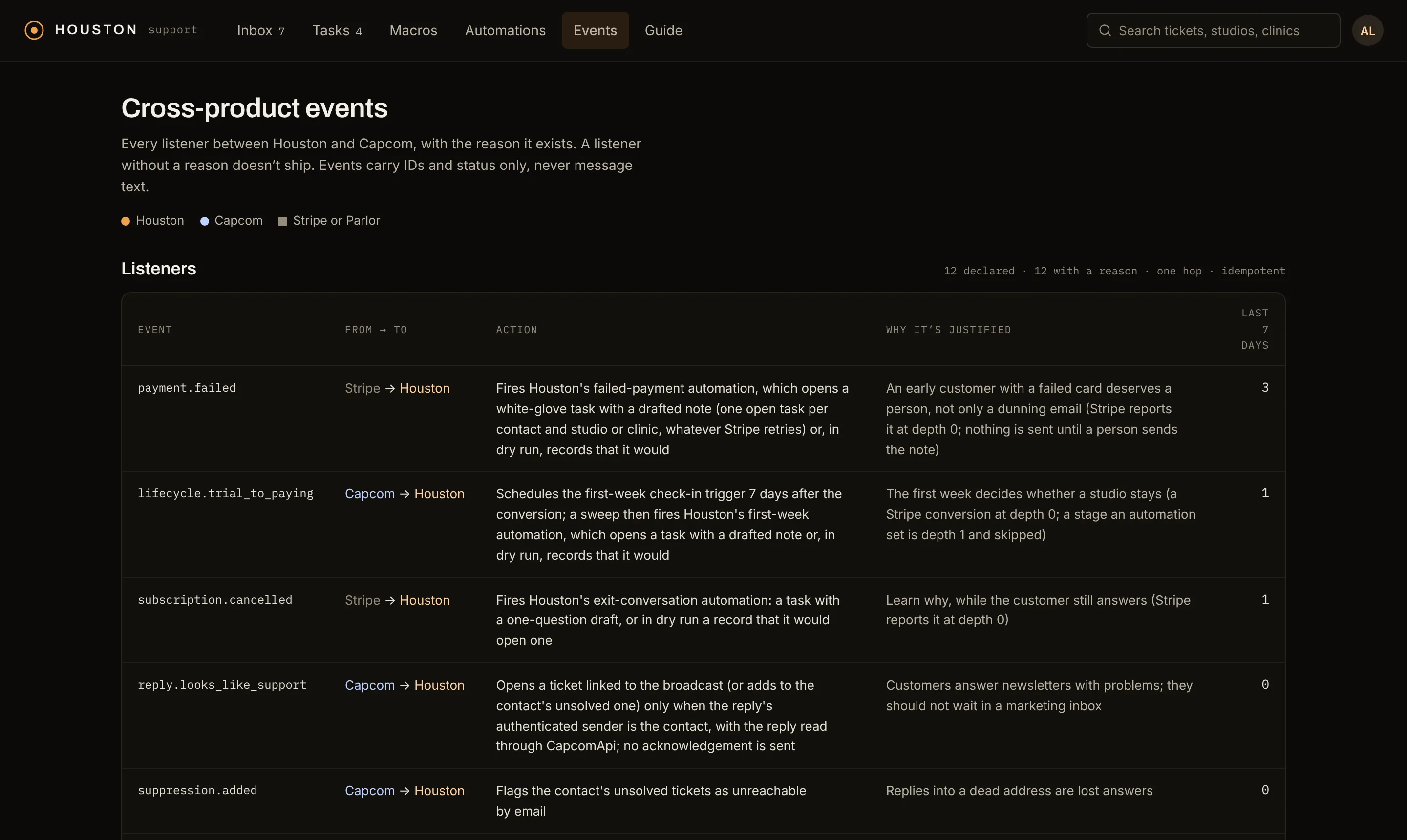
Houston’s Events screen lists every listener between the products, with the reason it exists, word for word from the manifest. The seven-day counts are mock data.
One customer, two jobs
A salon owner hears from us in two ways. Capcom, our CRM, writes to many customers at once: the October product update, onboarding, a failed-payment email. Houston, our support desk, answers one customer who wrote in. It is the same person, so each product needs to know what the other did. Neither should be able to act in the other’s name.
One test decides where a feature lives. If it goes to many people from a template, it belongs in Capcom. If a customer starts it, or a person writes to one customer, it belongs in Houston.
Capcom
Houston
Who starts it
We do, for many people at once
A customer, or a person writing to one customer
For example
The October update to every studio; onboarding and failed-payment emails; segments and A/B tests
“My booking page is down”; the reply to that ticket; a personal check-in after a studio’s first week
What it sends
Templates, after a dry run, a test and a first batch of 25
Only what a person approves
What it owns
Contacts, consent, the suppression list, email delivery
Both products run in the same API, but each owns its own tables, and neither reads the other’s. They share exactly three things.
Contacts. Capcom owns every customer record. Houston reads it, and when a stranger writes to support, Houston asks Capcom to create the contact. There is never a second copy of a customer.
The suppression list. A hard bounce or a spam complaint on a support reply suppresses that address everywhere. A marketing unsubscribe stops broadcasts but not support replies, because a reply to someone’s own question is not marketing.
Email delivery. Both send through Amazon SES, but support mail comes from the help. subdomain and broadcasts from news. subdomains, so a complaint about a newsletter cannot hurt the reputation of support mail.
Every crossing has a written reason
Everything else that passes between them is an event on a bus. A listener is declared in one manifest with three parts: the event it hears, what it does, and why that is justified. A listener without a reason fails a test and does not ship. Houston’s Events screen reads the same manifest, so the reasons on screen are the reasons in the code.
Into Houston
A payment failed (Capcom relays it)Stripepayment.failedA task with a drafted personal noteHouston
A subscription was cancelledStripesubscription.cancelledA task to ask why, while they still answerHouston
A trial became a paying customerCapcomlifecycle.trial_to_payingA first-week check-in, seven days onHouston
A reply to a broadcast asks for helpCapcomreply.looks_like_supportA ticket, linked to the broadcastHouston
An address was suppressedCapcomsuppression.addedIts open tickets flagged unreachableHouston
A studio took its first online bookingParlorbooking.firstA congratulations taskHouston
Bookings fell week over weekParlorbookings.droppedA check-in taskHouston
Into Capcom
Marketing to the contact heldCapcomticket.open_on_contactA ticket opensHouston
A line on the contact’s timelineCapcomticket.openedA ticket opensHouston
Hold lifted; solve time on the timelineCapcomticket.solvedThe ticket is solvedHouston
Marketing held 14 days; staff emailedCapcomrating.lowA satisfaction rating of 1 or 2Houston
Twelve listeners, each declared in one manifest with the reason it exists (ticket.solved is two: the hold and the timeline). Events carry ids and statuses, never message text.
An open ticket holds marketing
Nobody waiting on a fix should get “upgrade now” in the meantime. When a Houston ticket opens, Capcom holds broadcasts and sequence steps to that contact until it is solved. Nobody approves the hold, and that is safe: it can only stop a message, never send one.
The manifest also declares that a satisfaction rating of 1 or 2 holds marketing for 14 days and emails us. Ratings themselves come later.
Broadcast
What’s new in October
Marketing · five studios
Gia’s StudioSent
Lou AestheticsSent
Fade RoomHouston ticket openSuppressed · marketing held (support ticket open)Ticket solvedHold lifted · the next broadcast reaches them
Northside BarberSent
Glow Med SpaSent
An open ticket holds marketing to that contact. The held copy is recorded, not sent later. A sequence step waits instead and retries every six hours. Receipts, sign-in links and support replies are not marketing and are never held. Studios are invented.
Support on the timeline, without the words
Capcom’s contact timeline shows when a ticket opened and how long it took to solve, with a link that opens it in Houston. It never shows the ticket’s subject or a single line of the conversation. Before writing to a customer, you can see that they had a problem last week and how long it took to solve, without the details of that conversation ever reaching a marketing system.
The first version had a gap. Capcom’s timeline did not recognise the new kind of entry, so a contact with a support ticket would have failed to load. We caught it on Wednesday morning, before the first real ticket arrived. The fix was one small change in Capcom: accept support entries, label them, and link back to Houston.
Houston shows the other side. Next to every ticket, the customer column lists the latest entries on their Capcom timeline, such as a contact created or a ticket opened.
Six rules every crossing follows
Declared, with a reason. One manifest lists every listener. No reason, no listener.
Ids, not bodies. Events carry ids, statuses and times. Message text never crosses, which matters for a product that serves medical spas.
One hop. An action caused by the other product’s event cannot set off another crossing, so the two can never trigger each other in a loop.
Idempotent. Each listener records the events it handled and ignores a repeat.
Logged on both sides. Every crossing is in Capcom’s audit log and in Houston’s.
Customer-facing means reviewed. Holding a message can happen automatically. Sending one never happens because of the other product’s event; at most it opens a task with a draft for a person.
The first real test
On Wednesday afternoon we wrote to both support addresses from an ordinary mail account. The first email opened a Parlor ticket at 1:55 PM and created the Capcom contact. The second opened a Lunar MD ticket at 1:59 PM on the same contact. Capcom’s timeline showed both tickets opening. A few minutes later we solved them, and the timeline read “solved in 4m” and “solved in 1m”, each with a link back to Houston.
What we took from it
Build the second product as a listener. Houston is not a support tab inside the CRM. It hears what Capcom says, Capcom hears what it says, and either can change without breaking the other.
Write the reason before the code. A listener that cannot explain itself in one sentence is usually one we did not need.
Pass ids, not words. The less a message carries, the less there is to leak, and the less a marketing tool ever learns about a support conversation.
Let protection be automatic and sending be human. Holding marketing is always safe. Reaching a customer always waits for a person.