Blog / Case study

Capcom: off Brevo and onto our own CRM in one weekend

On a Saturday evening we started moving every email our apps send off Brevo and building our own CRM. Twenty-three hours later, with a night’s sleep and an eight-hour drive in between, it was live.

First pull request to live
23 h 15 m, sleep included
Pull requests
48, all by Claude Code
Delivery
Amazon SES · toll-free SMS
People
One, plus Claude
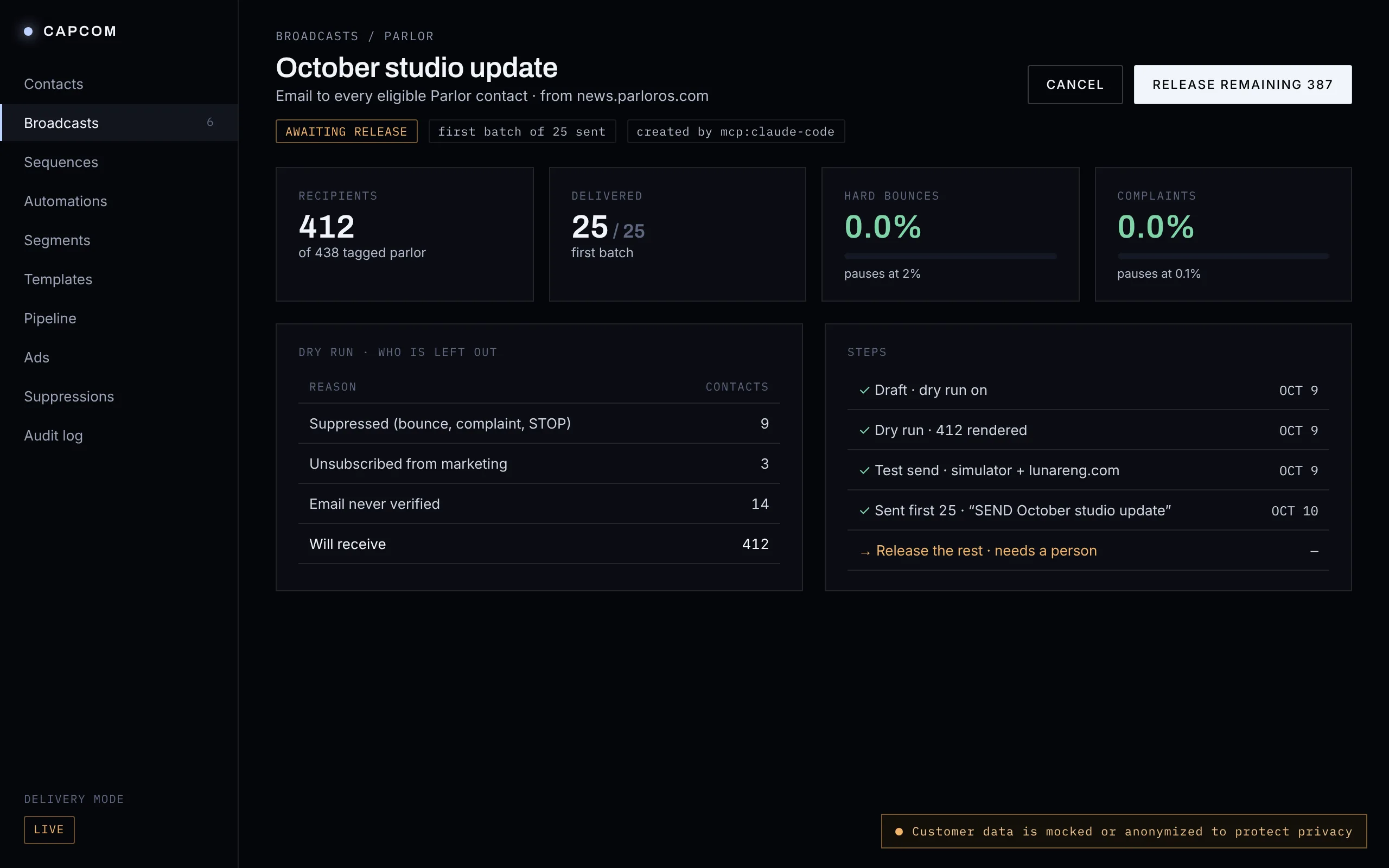
Capcom broadcast screen: 412 recipients, first batch of 25 delivered, zero bounces and complaints, waiting for a person to release the rest.
A broadcast waiting for a person to release it. Privacy note: all customer data in this post’s screens is mocked or anonymized. Names, businesses, addresses and figures are not real.

Where we started

Lunar Engineering runs two products, Parlor for salons and Lunar MD for medical spas. Until that Saturday, Brevo carried every email our apps send: sign-in links, receipts and booking confirmations. Our signup forms fed Brevo lists, and our compliance platform relayed its mail through Brevo too.

Text messages were the breaking point. Brevo denied our toll-free number registration, and the support ticket sat for weeks. We needed texting for both products, so we decided to move sending to AWS (Amazon SES for email, our own registered toll-free number for text) and build the CRM ourselves.

That made this a migration, not a fresh start. Production email was live the whole time, and every sign-in link had to keep arriving while we switched providers under it.

One rule shaped the build. Every tool our business adopts has to be usable by our agents, not just by a person in a browser. A CRM our agents could not drive was not worth building.

The plan

Before any code, we wrote down what the CRM may never do, then what it must do, in order. Anything that sends a message waited until the brakes existed.

  • Only our people get in. Capcom is reachable only from our own private network, and only our team can sign in.
  • Nobody's patients, ever. Contacts are business owners and their staff. Patients and a salon's own clients never enter Capcom, and the schema enforces it.
  • Production only, so safety is built in. No test environment. Every broadcast starts as a dry run, test sends go only to our own inboxes and the SES simulator, and the first real send stops at 25 recipients.
  • The law is a feature. One-click unsubscribe and our mailing address on marketing email, opt-in before marketing texts, and “Reply STOP to opt out” on the first one.

One weekend

The first pull request opened at 6:56 PM on Saturday. By 10:43 PM every production email from every app was off Brevo and on SES. The core CRM was merged before 1:30 AM. After a night's sleep, Sunday added ads, revenue per ad and the move of our last Brevo mail, and Capcom went live at 6:11 PM.
  1. Sat 6:56 PM0:00Plan written, repository set up
  2. Sat 7:53 PM0:57Email (SES), inbound mail, delivery events, text messaging and DNS
  3. Sat 8:24 PM1:28Admin app: theme, passkey sign-in, deploy
  4. Sat 9:08 PM2:12Agent access, suppression list, delivery events, contacts, MCP tools
  5. Sat 9:55 PM2:59Broadcasts, text messages, STOP sync
  6. Sat 10:43 PM3:47All production email moved off Brevo, onto SES
  7. Sat 10:58 PM4:02Attribution, contacts from signups, send safety
  8. Sat 11:09 PM4:13Timeline, notes, Stripe-triggered sequences, automations
  9. Sat 11:47 PM4:51Segments, templates, pipeline, tracking, replies, A/B tests
  10. Sun 12:11 AM5:15Agent access in production
  11. Sun 1:18 AM6:22Admin app, every screen
  12. 1:18–7:46 AMSleep
  13. Sun 8:56 AM14:00Compliance platform mail moved off Brevo
  14. Sun 10:49 AM15:53Ads and creatives
  15. Sun 11:16 AM16:20Revenue and return on ad spend per ad, from Stripe
  16. Sun 5:55 PM22:59Delivery mode: log only → test sends only
  17. Sun 6:11 PM23:15Live in production
Real merge times, Eastern. 23 hours 15 minutes from the first pull request to live, sleep included.

Brakes first

The first thing we built was the piece that says no. A single suppression list sits in front of every email and text. Unsubscribes, STOP replies, hard bounces and spam complaints all land in it automatically. It is keyed by the address itself, not the contact, so an opt-out survives a deleted contact and a re-import.

Broadcasts then follow one path with no shortcuts. If bounces pass 2% or complaints pass 0.1%, the levels that keep an email account in good standing, the broadcast pauses itself and waits for a person.

A broadcast passes a suppression and consent check, a dry run, a first batch of 25 and a person's release before delivery. Bounces, complaints and STOP replies return to the suppression list. Bounces, complaints and STOP replies are suppressed automaticallyContactsevery Parlor tagChecksuppressed? consent?Dry runrender + countFirst 25sent, then watchedReleasea person says goDeliveredSES · toll-free SMSleft out, never sentpauses itself at 2% bouncesor 0.1% complaints
Every send takes the same path. Nothing skips the check, and nothing goes past 25 without a person.

Then the whole CRM

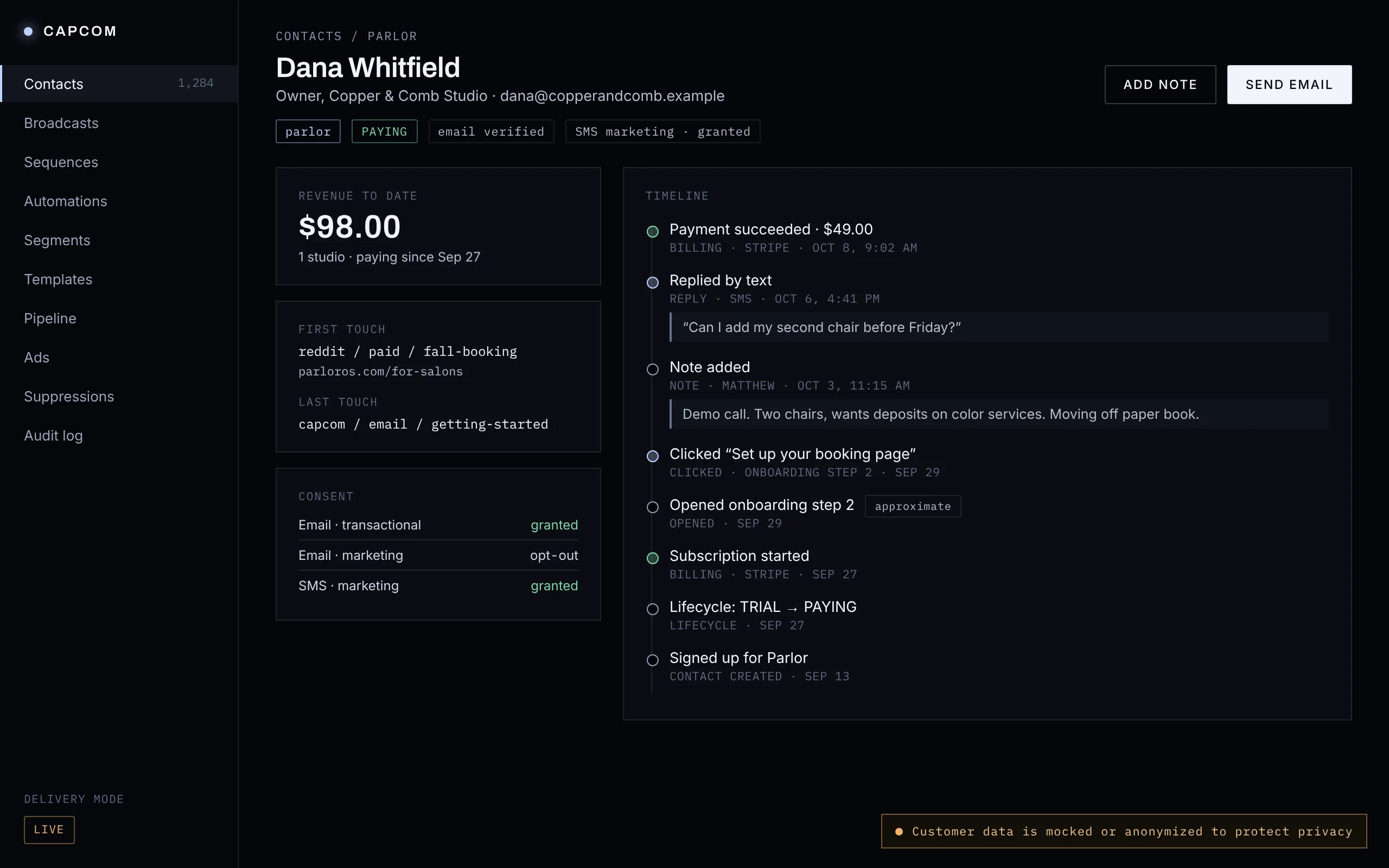
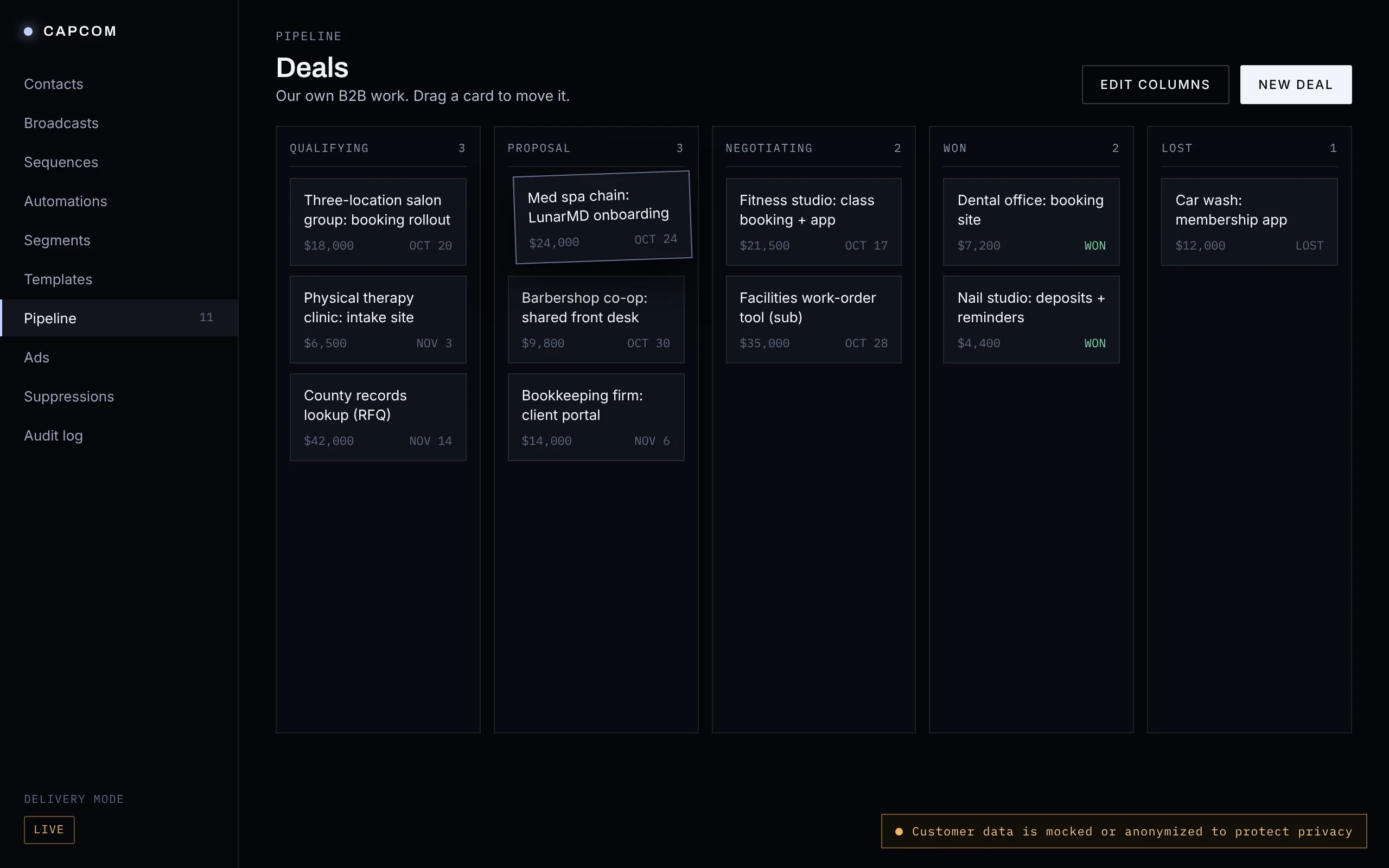
With the safety layer in place, the rest came quickly: one timeline per contact, saved segments, Stripe-driven sequences, open and click tracking, replies by email and text, a deal pipeline, an automation builder, subject-line tests and ad attribution. The design matches this site, so it reads as part of the same company.

Capcom contact page for a mock salon owner: revenue, first and last touch, consent, and a timeline of payments, a text reply, a call note, email clicks and signup.
One feed per contact: billing events, messages and what happened to them, replies and notes. Opens are marked approximate, because Apple Mail preloads tracking pixels. The contact shown is invented.
Capcom pipeline board with mock deals in Qualifying, Proposal, Negotiating, Won and Lost columns.
The pipeline for our own client and contract work. Cards drag between columns. Deals shown are mock data.

Brevo and Capcom, for us

This is not a review of Brevo. It is what each one did for a two-product company that needed text messaging and agents it could trust.

Brevo, as we used itCapcom
Transactional emailCarried every app's sign-in, receipt and booking emailAmazon SES with our own settings: TLS required, bounces and complaints suppressed
Text messagesToll-free registration denied; support ticket stuck for weeksOur own registered toll-free number; STOP replies sync to suppressions
ContactsLists fed by signup formsCreated from Parlor and Lunar MD signups, with consent and first and last touch
AgentsAn MCP server over Brevo's APILimits enforced in our API: two permissions, a typed confirmation to send, an audit log
Who gets inBrevo accountsOur team only, on our own private network
PipelineDealsA deal board. Parity, not a reason to switch

Built for agents first

Everything in Capcom can be done by an agent through MCP, the protocol AI assistants use to call tools. The admin screens exist for a person to review and approve. That only works if the agent cannot do damage by mistake, so the limits live in the API, not in a prompt:

  • Two permissions. The everyday one can draft, dry-run, test, and edit sequences and automations, which are always created switched off. Sending and switching things on need a second, separate permission.
  • Type the name to send. A send must include the confirm text “SEND” plus the broadcast's exact name. A wrong or vague request cannot send anything.
  • Every write is signed. The audit log records which agent did what, next to every person's action.

youDraft the October studio update for Parlor and show me who it reaches.

toolcapcom_create_broadcast

→DRAFT · dry run on

toolcapcom_dry_run_broadcast

→412 recipients · 26 left out (9 suppressed, 3 unsubscribed, 14 unverified)

toolcapcom_test_send_broadcast

→sent to the SES simulator and a lunareng.com inbox

agentReady. Sending is a separate permission and needs the confirm text “SEND October studio update”. Send the first 25?

youSend it.

toolcapcom_send_broadcast confirm="SEND October studio update"

→first 25 sent · AWAITING_RELEASE

agent25 of 25 delivered, no bounces, no complaints. The other 387 wait for you to release them.

Replay with mocked data; no real customers appear. The agent can draft, dry-run and test on its own; sending needs a second scope and the broadcast's exact name.

How it was built

One person and Claude Code. Claude wrote the code, the infrastructure and the runbooks, opened every one of the 48 pull requests, and ran the migrations. I set the rules, reviewed and approved.

Sunday included an eight-hour drive. I took Capcom to production with my hands on the wheel, working and approving at stops. The timeline above is real merge times, sleep included.

Working with Claude has changed what one person can take on. Claude does the work, and my job is deciding what the work must never do.

Matthew Orahood, founder

What we took from it

  1. Speed is no longer the hard part. Capcom was live 23 hours after the first pull request. The time that mattered went into deciding what it must never do.
  2. Build the brakes before the engine. Suppression, consent and the first-25 rule came before the first real send, so we never had to retrofit safety.
  3. Treat agents like a new hire. Give them real access, a narrow default, and a second key for anything that reaches a customer.
  4. A live migration can be fast if it is ordered. Production email moved in the first four hours, before any feature that depended on it.